
A customer sends an enquiry. Someone copies it into a spreadsheet. Another person forwards it to sales. Two days later, everyone assumes someone else has replied.
For a small business, this is a familiar problem. Work gets stuck between people, inboxes and tools.
Business process automation for SMEs helps close those gaps. It connects routine steps so your team spends less time chasing information and more time serving customers.
The best place to start? A task you repeat every week and wish you did not have to.
Seven everyday tasks worth automating
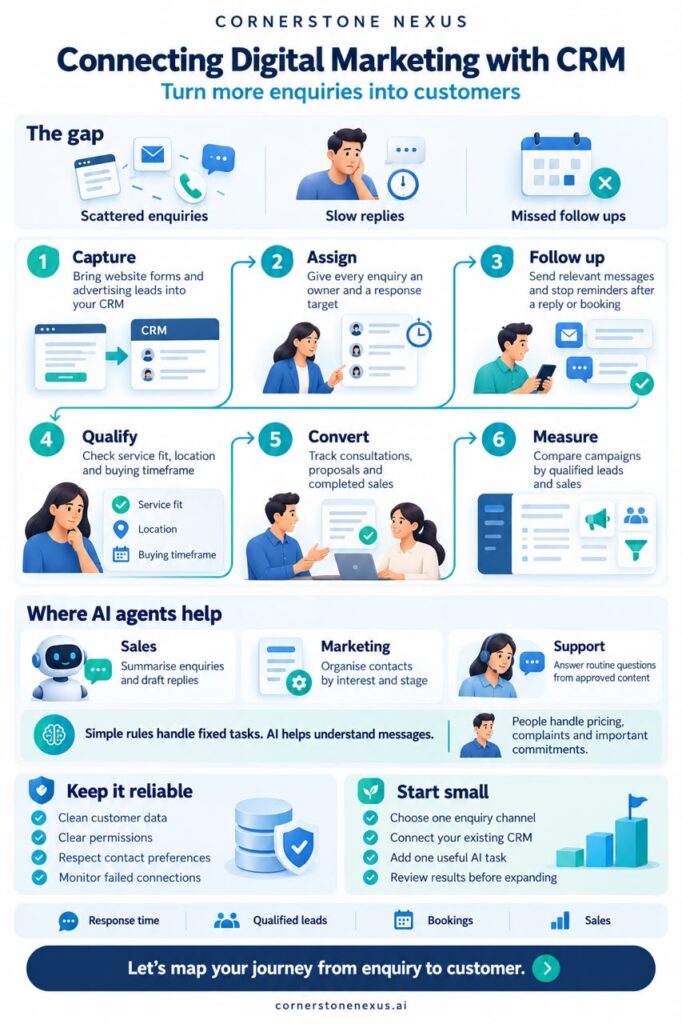
1. Capture enquiries before they get lost
Connect your website enquiry form to your CRM so each submission creates or updates a contact, records what they need and alerts the right person.
Send a short acknowledgement that explains what happens next. Check for duplicate records using an email address or another reliable identifier.
An acknowledgement reassures the customer. It still needs to be followed by a useful reply.
2. Give every lead a clear owner
CRM automation can assign enquiries by service, location or team availability. A website project goes to your digital team. An automation enquiry goes to the person handling workflows.
Always include a fallback owner. If an enquiry does not match your rules, it should reach someone who can route it.
3. Make follow up easier to remember
Create a reminder when a lead has not received a response within your agreed timeframe, or when a proposal needs attention.
Start with reminders for your team. If you later automate customer messages, stop the sequence when someone replies, declines or books a meeting. Nobody enjoys being chased after they have already answered.
4. Cut the back and forth of scheduling
Let customers choose from available appointment slots, then send a confirmation and reminder.
Set realistic meeting lengths, allow preparation time and display the correct time zone. Give people an easy way to reschedule. A booking calendar should make your day manageable.
5. Give onboarding a consistent start
Once a customer accepts a proposal, trigger a welcome message, an information form and an internal task list.
Keep the requirements relevant to the service. A marketing client might need to share brand assets. A CRM client may need to identify who requires access.
Collect sensitive information through an appropriate secure channel and ask a person to confirm that everything needed is in place.
6. Send invoice reminders at the right time
Schedule polite reminders around payment dates, using the current payment status from your accounting system.
Pause reminders for paid or disputed invoices. Let your finance team handle exceptions, payment arrangements and sensitive conversations.
7. Bring reporting into one place
Schedule a report showing enquiries, response times, appointments, outstanding invoices or campaign results.
Agree on what each metric means before connecting the data. For digital marketing reporting, distinguish enquiries from qualified leads and actual sales. Someone should review unusual changes before the team acts on them.
Task → automation → human checkpoint
| Task | Automation | Human checkpoint |
|---|---|---|
| Enquiry capture | Save the enquiry in your CRM and acknowledge receipt | Review unclear requests |
| Lead assignment | Route the lead using agreed criteria | Handle unmatched enquiries |
| Follow up reminders | Create a task when action is due | Choose the next useful response |
| Appointment scheduling | Offer slots and send reminders | Handle special requests |
| Customer onboarding | Send forms and create internal tasks | Confirm readiness |
| Invoice reminders | Send messages based on payment status | Resolve disputes |
| Reporting | Compile agreed metrics on a schedule | Check accuracy and interpret results |
When do you actually need AI?
A simple rule based workflow is enough when the next step is predictable: a form arrives, a contact is created, a team member is notified.
AI adds value when the input needs interpretation. It can help summarise a long enquiry, identify its likely subject or draft a response for review. These uses suit information that arrives in varied wording rather than neat form fields.
Start with one clearly defined AI task and check its output. Keep human approval for commitments such as pricing, discounts or delivery promises.
“Our latest financial report highlights Execor’s strong growth, innovation, and commitment to delivering value. We remain focused on sustainable success and excellence."
John Smith, CEO & Owner Tweet
Choose your first workflow
Before building anything, use this checklist:
- The task happens often enough to justify the setup.
- The steps are clear and reasonably consistent.
- The information needed is available and reliable.
- One person owns the workflow and its exceptions.
- You can measure an improvement, such as response time or minutes saved.
- You know what should happen if a step fails.
Test with sample records first, including duplicates, missing details and unexpected replies. Then run a small pilot and compare the result with your current process.
For many SMEs, enquiry capture and lead assignment make a sensible starting point. They address a visible problem: a potential customer waiting for someone to respond.
One dependable workflow gives your team a practical foundation for intelligent automation, with room to improve as the business grows.
I look forward to seeing how these developments will improve service levels and customer satisfaction in the freight industry!